Graco Baby brand logo
A young baby looking into the camera, being held by a woman with her back to the camera.

Baby Milestones: What to Expect in Your Little One’s First Year

Every baby grows and develops at their own pace, but watching your little one reach new milestones is one of the most exciting and memorable parts of parenthood. From the very first smile to those wobbly first steps, each milestone represents an important stage in your baby’s physical, cognitive, emotional and social development. It’s natural for parents to wonder what’s coming next and whether their baby is developing as expected. While milestones can offer helpful guidance, they are not strict rules or deadlines. Some babies move quickly in one area and take more time in another—and that’s perfectly normal. In this guide, we’ll walk through key baby milestones during the first year of life and share simple, practical ways you can support your baby as they grow, learn and explore the world around them.

Understanding Baby Milestones

Baby milestones are skills or behaviours that most babies develop within a certain age range. They’re often grouped into areas such as:

Physical development (movement, coordination and strength)
Cognitive development (learning, problem-solving and curiosity)
Communication and language (sounds, gestures and words)
Social and emotional development (relationships, emotions and self-awareness)

Milestones are used by healthcare professionals as a general guide to monitor development, but they don’t define your baby’s potential or future abilities. Every baby follows their own unique path.

Newborn to 3 Months: Discovering the World

The first three months are a period of rapid adjustment as your baby adapts to life outside the womb. Much of your baby’s time is spent sleeping, feeding and gradually becoming more alert to their surroundings.

Common milestones during this stage include:

• Lifting their head briefly during tummy time
• Turning their head toward sounds or familiar voices
• Making eye contact and focusing on faces
• Smiling for the first time (often called a “social smile”)
• Beginning to coo and make gentle vowel sounds
• Bringing hands toward their mouth

Your baby is also learning to regulate their basic needs, such as feeding and sleep, with your help.

How to support your baby:

Talk and sing often: Hearing your voice supports early language and emotional bonding.
Offer regular tummy time: Short, frequent sessions help strengthen neck, shoulder and core muscles.
Respond to cues: Comforting your baby when they cry helps them feel secure and understood.
Create a calm environment: Soft lighting and gentle sounds can help your newborn feel safe and settled.

4 to 6 Months: Building Strength and Curiosity

Between four and six months, many babies become more physically active and socially engaged. Their growing strength allows them to explore movement, while their curiosity about people and objects increases.

Common milestones during this stage include:

• Rolling from tummy to back or back to tummy
• Pushing up on arms during tummy time
• Reaching for and grasping toys
• Bringing objects to their mouth
• Laughing, squealing and showing excitement
• Recognising familiar faces and voices

You may also notice your baby becoming more expressive, using different sounds and facial expressions to communicate.

How to support your baby:

Encourage floor play: Allow your baby time to move freely and practise new skills.
Offer safe toys: Toys with different textures, colours and sounds support sensory development.
Respond to communication: Copy your baby’s sounds and expressions to encourage interaction.
Maintain routines: Consistent feeding and sleep routines help provide a sense of predictability.

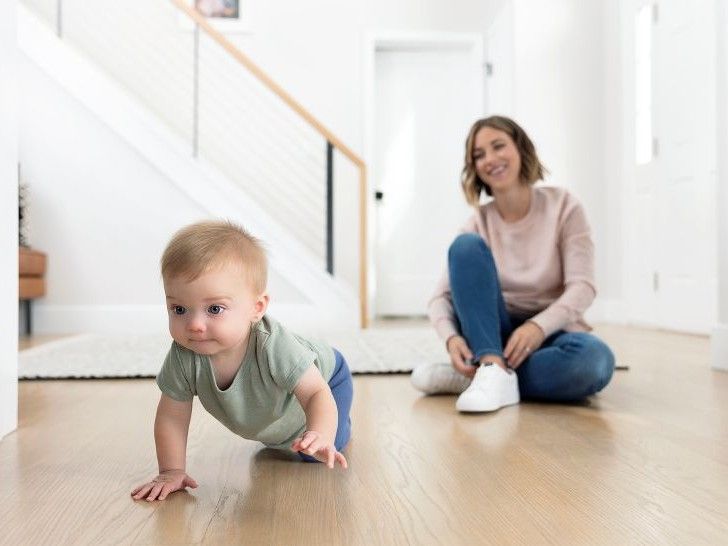
A young baby crawling along a wooden floor with a woman sitting in the background watching.

7 to 9 Months: On the Move

This stage is often marked by increased mobility and independence. Many babies become eager explorers as they gain new movement skills and greater awareness of their environment.

Common milestones during this stage include:

• Sitting without support
• Crawling, shuffling or rolling to get around
• Pulling themselves up to stand
• Transferring objects from one hand to the other
• Babbling using repeated sounds like “ba,” “da” or “ma”
• Responding to their name

You may also notice signs of separation anxiety, as your baby becomes more aware of familiar and unfamiliar people.

How to support your baby:

Create a safe space: Baby-proof your home to allow safe exploration.
Talk about actions: Describe what your baby is doing to support language development.
Play interactive games: Simple games like peekaboo help build social and emotional skills.
Offer reassurance: Comfort your baby during moments of uncertainty or frustration.

10 to 12 Months: Big Steps Forward

As your baby approaches their first birthday, development often accelerates. Many babies become more confident movers and communicators during this stage.

Common milestones during this stage include:

• Cruising along furniture or taking first independent steps
• Standing without support for short periods
• Using gestures such as pointing, waving or clapping
• Saying their first words, such as “mama” or “dada”
• Following simple instructions
• Showing preferences for favourite people, toys or activities

Your baby’s personality may become more apparent, with clear likes, dislikes and emotional responses.

How to support your baby:

Encourage exploration: Provide opportunities for movement while maintaining safety.
Support communication: Name objects, read books together and respond to attempts at speech.
Maintain routines: Familiar routines provide comfort during times of rapid change.
Celebrate progress: Every new skill—big or small—is worth celebrating.

Baby Milestones: Frequently Asked Questions

When should my baby start rolling over?

Most babies begin rolling over between 4 and 6 months, although some may do it earlier or later. Regular tummy time helps build the muscle strength needed for this milestone.

When do babies usually start sitting up?

Many babies can sit with support around 4–5 months and independently by 6–8 months. Balance and core strength develop gradually through floor play and movement.

At what age do babies crawl?

Babies often start crawling between 7 and 10 months, but not all babies crawl before walking. Some may bottom-shuffle or move straight to standing and walking.

When do babies say their first words?

First words typically appear between 9 and 12 months, though babbling begins much earlier. Talking, singing and reading together can support language development.

When should my baby start walking?

Most babies take their first steps between 9 and 15 months. Some may walk earlier, while others take more time to build strength and confidence.

Should I be worried if my baby reaches milestones later?

Milestones are a guide, not a deadline. If you have concerns about your baby’s development, it’s always best to speak with a healthcare professional for personalised advice.

How can I support my baby’s development at home?

Simple everyday activities make a big difference—talking to your baby, encouraging movement through play, offering comfort and creating a safe environment all help support healthy development.


Remember: Every Baby Is Unique

Milestones can be helpful reference points, but they don’t tell the whole story. Some babies focus on physical skills first, while others concentrate on communication or social interaction. Development is not a race, and comparison can sometimes cause unnecessary worry.


If you ever feel unsure, your healthcare professional can provide reassurance and guidance tailored to your baby’s individual needs.


Supporting your baby through their first year is about providing love, safety and opportunities to explore. With patience, encouragement and a nurturing environment, your baby can grow and thrive in their own time.

share:

Links

Follow Us

© 2025 Graco Children's Products. All Rights Reserved.

Nuna International B.V. Groenmarktkade 5 H, 1016 TA, Amsterdam, The Netherlands